

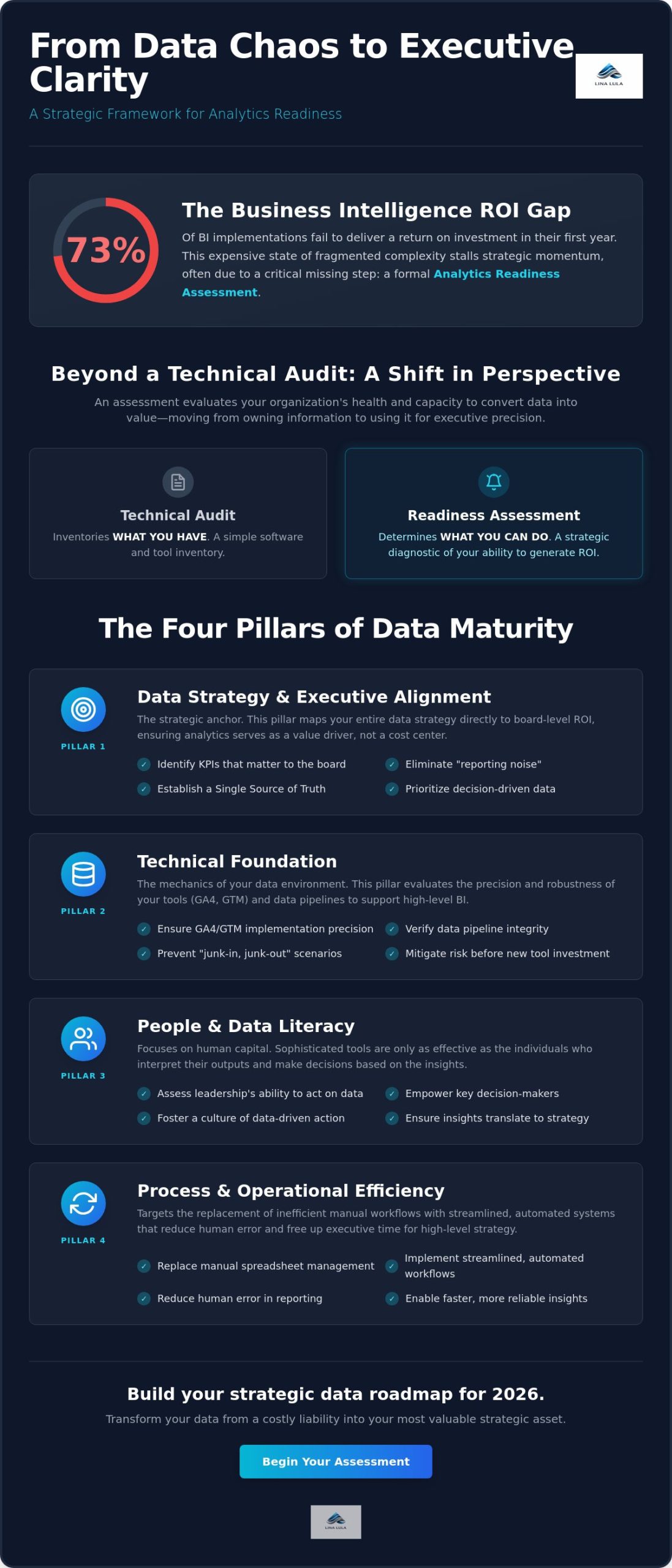
73% of business intelligence implementations fail to deliver a return on investment within their first year. This failure often stems from a lack of a formal analytics readiness assessment, leading to manual spreadsheet management and conflicting data across departments. You’ve likely authorized significant investments in tools like GA4, yet find the output lacks the clarity needed for decisive action. It’s an expensive state of fragmented complexity that stalls strategic momentum.
This guide demonstrates how evaluating your data maturity serves as the bridge between raw information and executive precision. We’ll show you how to identify the gaps in your data foundation to eliminate reporting noise and drive a tangible ROI. By the end of this article, you’ll understand the roadmap required to transition from manual workflows to a single source of truth for board-level reporting. We’ll explore the logical progression from operational chaos to the strategic clarity required for success in 2026.
Key Takeaways
- Shift your perspective from a simple technical audit to a strategic analytics readiness assessment that evaluates organizational health rather than just software inventory.
- Master the Four Pillars of data maturity to ensure your analytical capabilities align directly with board-level ROI expectations.
- Bridge the “reporting noise gap” by replacing manual, conflicting spreadsheets with automated executive dashboards that provide a single source of truth.
- Implement a five-step framework for stakeholder discovery and alignment to transform data chaos into a structured, actionable roadmap for 2026.
What is an Analytics Readiness Assessment? Beyond the Technical Audit
An analytics readiness assessment is a strategic diagnostic designed to evaluate an organization’s data health and its capacity to convert information into value. Many leaders mistake a technical audit for a readiness review, but the two serve different masters. While an audit inventories what you have, an assessment determines what you can actually do. It’s the difference between owning a library and being able to extract the specific answers needed to drive a business forward. This process moves your organization from fragmented complexity to a future state of streamlined efficiency.
In 2026, the stakes for this evaluation have shifted significantly. With the EU AI Act transparency obligations becoming fully applicable on August 2, 2026, and Gartner predicting that 80% of enterprises will have deployed AI-augmented analytics, readiness is no longer optional. It’s the foundation of modern Business intelligence. Organizations must now account for rigorous data governance and AI-readiness to remain competitive and compliant. A professional assessment identifies these gaps before they become liabilities.
The Strategic Difference: Data vs. Insights
Collecting data through platforms like GA4 or GTM represents only 20% of the readiness equation. True maturity lies in the ability to generate “Decision-Driven Data.” This concept prioritizes the output over the intake. An assessment forces executive clarity by defining what “ready” looks like in the context of your specific KPIs. It ensures that the data being harvested is actually capable of answering the board’s most pressing questions rather than just filling up a database. Without this alignment, you’re simply accumulating digital noise.
Why a Readiness Review is Mandatory Before New Tool Implementation
Organizations often fall into the “Tool-First Trap,” purchasing licenses for Power BI or Tableau before their data foundation is stable. Buying a faster engine won’t help if the fuel is contaminated. Without an analytics readiness assessment, you’re simply automating bad data or creating “junk-in, junk-out” scenarios. This review acts as a critical risk-mitigation strategy for high-level business outcomes. It ensures that your investment in new technology translates into actionable intelligence rather than becoming another expensive, underutilized asset. By identifying infrastructure gaps early, you ensure that new tools serve your strategy rather than complicating it.
The Four Pillars of Organizational Data Maturity
A rigorous analytics readiness assessment evaluates the structural integrity of an organization across four distinct domains. This framework ensures that your data environment functions as a cohesive engine for growth rather than a collection of isolated silos. By examining these pillars, leadership can move from a state of uncertainty to one of informed, confident action. This transition is essential for organizations looking to leverage data as a competitive advantage in a crowded market.
The Alignment Pillar serves as the strategic anchor of the framework. It requires mapping your data strategy directly to organizational ROI. Without this connection, analytics remains a cost center rather than a value driver. The Technical Pillar addresses the mechanics of your environment, evaluating the precision of GA4 and GTM implementations along with existing data pipelines. It ensures that the technical foundation is robust enough to support high-level business intelligence.
The People Pillar focuses on human capital. It assesses whether your leadership team and key decision-makers possess the literacy required to act on insights. High-level tools are only as effective as the individuals interpreting them. Finally, the Process Pillar targets operational efficiency. It seeks to replace manual spreadsheet management with streamlined, automated workflows that reduce human error and free up executive time for high-level strategy. This transition from manual labor to automated precision is a hallmark of a mature organization, and it is a core component of any comprehensive analytics readiness assessment.
Pillar 1: Data Strategy and Executive Alignment
Success begins by identifying the metrics that matter to board members and stakeholders. Too often, organizations track vanity metrics that provide a false sense of progress without impacting the bottom line. A thorough assessment determines if your current KPIs actually drive business growth or merely represent reporting noise. The ultimate goal is the establishment of a Single Source of Truth in executive reporting. This eliminates the common pain point of conflicting data from different departments; ensuring every leader works from the same verified set of facts. This alignment transforms data from a technical byproduct into a strategic asset.
Pillar 2: Technical Infrastructure and Data Governance
Technical reliability is the bedrock of strategic clarity. This pillar evaluates the health of your tracking setup, specifically checking GA4 and GTM configurations for leaks, double-counting, or misattributions. Fragmented data sources often generate significant reporting noise, which creates friction and erodes trust in the numbers. Implementing robust data governance ensures long-term reliability and compliance with evolving privacy standards. If your current systems produce more confusion than clarity, a structured analytics readiness checklist can help identify where your infrastructure is failing and how to remediate those gaps.
Identifying the Reporting Noise Gap in Your Infrastructure
Reporting noise is the institutional friction caused by irrelevant, redundant, or conflicting data points. It’s the primary obstacle standing between a high-functioning executive team and strategic clarity. In a noisy environment, data acts as a distraction rather than a guide. Leaders find themselves buried in manual spreadsheets where the same metric might have three different values depending on which department generated the report. This fragmented complexity creates a culture of doubt, where the validity of the data is questioned more often than the strategy it’s meant to support.
The transition from reporting noise to calm authority requires a rigorous analytics readiness assessment. This process identifies where the static is originating and provides a roadmap for its elimination. By replacing manual, error-prone workflows with automated executive dashboards, an organization moves toward a future state of streamlined efficiency. The goal isn’t simply to have more data, but to achieve a state of precision where every dashboard provides a clear, unpolluted view of business health. This clarity allows leadership to focus on movement and transformation rather than forensic data reconciliation.
The Symptoms of Data Unreadiness
Unreadiness manifests in tangible operational drains. If high-level staff spend more than two hours per week on manual data entry or report preparation, your infrastructure is failing. This is a significant misallocation of expensive human capital. You’ll also notice that executive meetings frequently devolve into arguments about which department’s number is “correct,” effectively stalling strategic momentum. Additionally, a lack of clear marketing attribution makes it impossible to calculate true ROI, leaving the board to make high-stakes investment decisions based on intuition rather than evidence. These symptoms indicate a critical need for a structural realignment of your data assets.
The ROI of Eliminating Manual Reporting
Eliminating manual reporting workflows directly impacts institutional health and operational reliability. Automation removes the “human-in-the-loop” errors that plague manual spreadsheets, ensuring that the data presented to the board is both accurate and timely. This transition transforms complex, raw data into clear, actionable insights that drive financial impact. In an era where Gartner predicts that 80% of enterprises will deploy AI-augmented analytics by 2026, the ability to operate from a single source of truth is a significant competitive advantage. Moving from uncertainty to informed action allows your organization to respond to market shifts with a level of precision that competitors mired in data chaos cannot match.
Executing a Strategic Readiness Review: A Step-by-Step Framework
Transformation requires a structured path. A professional analytics readiness assessment isn’t a casual check-up; it’s a rigorous consulting framework that moves your organization from fragmented data silos to a unified, strategic ecosystem. This five-step process ensures that every technical decision serves a specific business outcome. By following a methodical progression, leadership can eliminate the guesswork that often plagues high-level reporting and tool implementation.
Step 1 & 2: Setting the Vision and Mapping the Landscape
Effective assessments don’t begin with code or server configurations. They start with Executive Innovation Workshops designed to align leadership on the “desired state” of the reporting ecosystem. These sessions identify the strategic goals that data must support before any technical work commences. This vision-first approach prevents the common mistake of building infrastructure for the wrong questions. Once the vision is established, the focus shifts to mapping the landscape. This involves identifying every fragmented data silo across the organization, from CRM exports to legacy spreadsheets. Consolidating these sources is the only way to establish a single source of truth and move away from the “from-to” narrative of fragmented complexity toward streamlined efficiency.
Step 3: Technical Integrity Audit. This stage validates the precision of your current environment. It involves checking GA4, GTM, and reporting automation triggers to ensure they function as intended. This audit confirms that the data being collected is accurate and that the triggers for automated workflows are reliable. It serves as a critical filter, ensuring that only high-quality data reaches the final reporting stage.
Step 4 & 5: KPI Alignment and the Final Roadmap
The fourth stage is KPI Mapping. This process bridges the gap between raw data and strategic business outcomes. We recommend selecting five key metrics that actually move the needle for the board. Tracking fifty metrics creates noise; tracking five creates focus and organizational alignment. These metrics must be directly linked to financial impact or operational reliability. Finally, we develop the Strategic Roadmap. This document outlines clear milestones, ROI targets, and the necessary tech stack for scaling. The Strategic Roadmap serves as the intellectual engine of future success. It provides a clear, logical progression from your current state of uncertainty to a future of informed, decisive action.
If you’re ready to move from data chaos to strategic clarity, you can download our analytics readiness checklist to begin evaluating your current infrastructure and identifying the gaps in your organizational data maturity.
From Assessment to Action: Building Your Strategic Data Roadmap
Completing an analytics readiness assessment marks the transition from organizational uncertainty to a state of calibrated focus. It’s a mistake to view the assessment as a static final report. Instead, consider it the architectural blueprint for your reporting ecosystem. While the diagnostic phase identifies the gaps in your data foundation, the subsequent roadmap provides the movement and transformation required to close them. This process moves your leadership team from the frustration of conflicting data points toward the relief of total strategic clarity.
The transition from assessment to action involves the integration of findings into tailored executive dashboards. These tools don’t just display data; they provide a high-level view of institutional health. By implementing ongoing reporting automation, you ensure that this clarity is maintained without the need for manual intervention. This shift allows your organization to operate with a level of precision that turns data from a technical burden into a powerful intellectual engine.
Lina Lula’s Approach to Analytics Strategy
Lina Lula operates as a trusted advisor rather than a mere service provider. Our methodology begins with an Analytics Readiness Checklist specifically designed for national organizations navigating complex data environments. We don’t view GA4 and GTM implementation as isolated technical tasks. Instead, we stabilize these platforms through a strategy-first lens, ensuring that every tag and event serves a board-level reporting requirement. This focus on executive decision support ensures that your investment in analytics technology translates directly into operational reliability and financial impact.
Our collaborative model prioritizes alignment between technical infrastructure and business vision. We work alongside your leadership to transform fragmented complexity into a streamlined workflow. This approach ensures that the output of your analytics environment is both actionable and accurate, providing the stabilizing force needed in a rapidly evolving market. By focusing on substance over style, we enable leaders to make high-stakes decisions with composed confidence.
Next Steps for Leadership Teams
Initiating a formal review doesn’t require a disruption of your daily operations. A professional consultant identifies institutional blind spots that internal teams might overlook due to organizational inertia. This external perspective is vital for uncovering the root causes of reporting noise and manual friction. By addressing these issues now, you prepare your organization for the increased demands of AI-augmented analytics and evolving data regulations expected in 2026. The logical progression from chaos to clarity begins with a single, purposeful step toward alignment.
If you’re ready to eliminate organizational confusion and establish a single source of truth for your board, the path forward is clear. Schedule a strategic consultation to evaluate your analytics readiness and begin building a roadmap that drives measurable ROI.
Establishing Strategic Clarity for 2026
Navigating the complexity of a data-driven market requires more than high-level tools; it demands a stable foundation. You’ve seen how the transition from manual, fragmented reporting to a streamlined executive dashboard relies on the four pillars of data maturity. By addressing the reporting noise gap, your organization moves from a state of uncertainty to one of informed, decisive action. This progression ensures that every technical investment serves your overarching business vision rather than complicating it.
A formal analytics readiness assessment provides the roadmap needed to achieve this transformation. At Lina Lula, we specialize in strategy-first implementations that prioritize executive clarity. Our national consulting experience in GA4 and GTM optimization allows us to consolidate fragmented data into a single source of truth for your board. We act as your intellectual engine, ensuring your infrastructure is built for long-term operational reliability and strategic ROI.
The path from data chaos to strategic precision is a logical consequence of a well-defined and rigorous process. You don’t have to manage this complexity alone. Request Your Strategic Analytics Readiness Assessment today to secure your organization’s future. Your journey toward total clarity starts now.
Frequently Asked Questions
How long does a typical analytics readiness assessment take?
A standard analytics readiness assessment typically spans three to six weeks depending on the complexity of your data ecosystem. This timeframe allows for thorough stakeholder discovery, technical auditing, and the development of a strategic roadmap. Larger national organizations with fragmented silos may require additional time to ensure every department aligns with the final reporting objectives and ROI expectations.
What is the primary difference between a data audit and a readiness assessment?
An audit focuses on technical inventory while an assessment evaluates strategic capability. While an audit identifies what tracking is currently active, a readiness review determines if that data can actually drive board-level decisions. It transitions your focus from a simple list of tools to a comprehensive evaluation of organizational alignment and decision-making health.
Do we need an assessment if we already have GA4 and Power BI set up?
Existing tools like GA4 and Power BI don’t guarantee strategic clarity. Many organizations possess high-level technology but suffer from reporting noise because their tools aren’t aligned with specific business outcomes. An assessment ensures your configuration supports executive decision-making rather than just collecting raw data that remains trapped in departmental silos or manual spreadsheets.
Who from our executive team needs to be involved in the assessment process?
Successful assessments require input from the CMO, CFO, and primary operations directors. These stakeholders define the metrics that matter and ensure the resulting data roadmap aligns with financial and growth objectives. Their involvement transforms the process from a technical exercise into a stabilizing force that enables informed action across the entire business.
What are the most common red flags found during a readiness review?
Frequent red flags include conflicting numbers between departments and excessive manual data entry. If your team spends hours reconciling spreadsheets before a meeting, your infrastructure is failing. We also often find a total lack of data governance, which leads to unreliable reporting and significant institutional risk during high-stakes decision-making sessions.
Can an assessment help us reduce our manual reporting workload immediately?
Yes, the assessment identifies specific manual workflows that are ripe for immediate automation. By mapping your current state, we highlight where human errors occur and how to replace them with reliable, automated triggers. This transition provides immediate relief to high-level staff who are currently overqualified for the data entry tasks they’re forced to perform.
How does an assessment impact our marketing attribution reporting?
An analytics readiness assessment stabilizes the tracking foundation required for accurate marketing attribution. By validating GA4 and GTM configurations, we ensure that every conversion and touchpoint is captured correctly. This precision allows you to calculate true ROI and allocate marketing spend with a level of confidence that intuition or fragmented data cannot provide.
What is the typical ROI of investing in a strategic data assessment?
The ROI stems from reclaimed executive time and the elimination of expensive strategic errors. While specific dollar amounts vary by organization, the transition from uncertainty to informed action prevents the failure of costly BI implementations. It ensures that your technology budget produces actionable intelligence rather than underutilized dashboards and organizational confusion.