

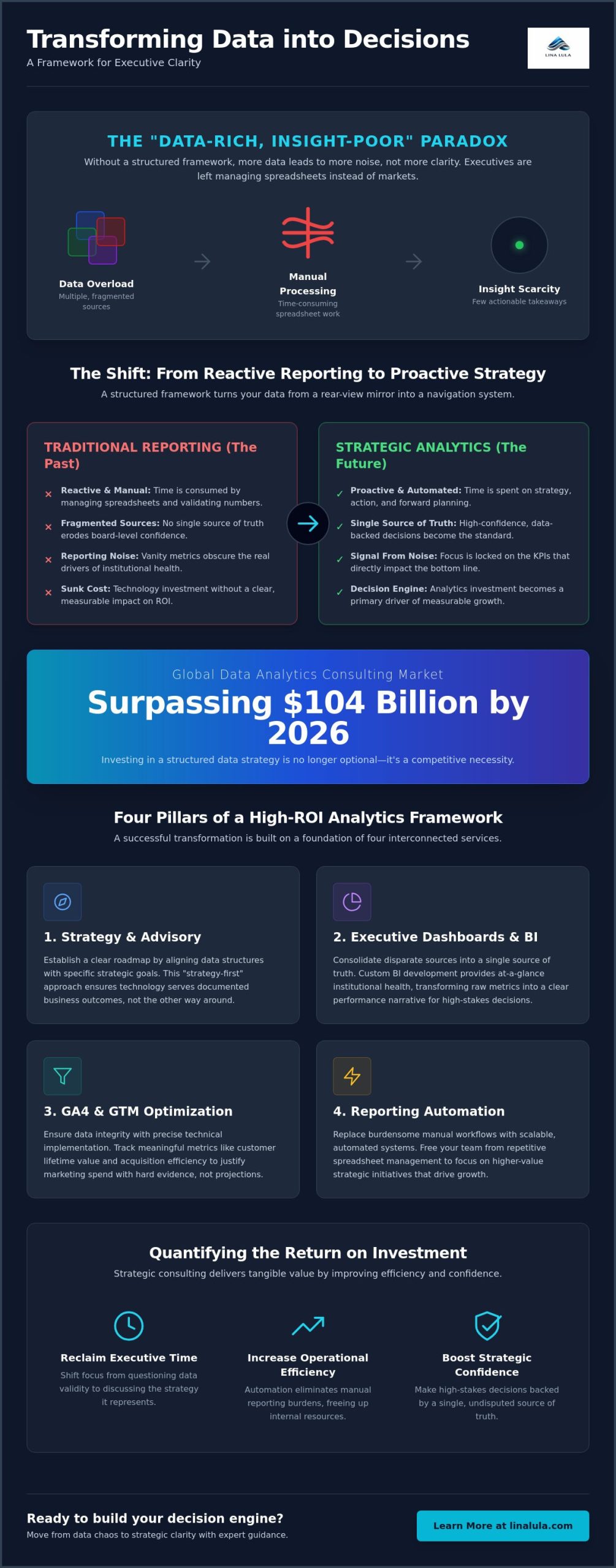
Most executives are currently drowning in data but starving for insight, even as the global market for data analytics consulting services surpasses $104 billion in 2026. You likely recognize the quiet frustration of reviewing a board-level report only to find that noise has obscured your primary KPIs. When manual spreadsheet management and fragmented sources create a broken version of the truth, the result isn’t just a delay; it’s a loss of strategic confidence.
You deserve a system where data functions as a decision engine rather than a library of static charts. This guide details how elite frameworks transform chaotic information into a strategic asset through structured processes designed for leadership. We’ll examine the shift toward automated reporting, the implementation of the new Open Semantic Interchange (OSI) v1.0 standard, and the specific methodologies that turn technical investments into clear, measurable ROI.
Key Takeaways
- Transition from a “data-rich, insight-poor” state to a structured framework where technical infrastructure directly supports executive vision.
- Identify the core pillars of professional data analytics consulting services to ensure your roadmap moves from fragmented sources to a single source of truth.
- Quantify the ROI of your analytics investment by measuring the impact of reporting automation on executive time and operational efficiency.
- Apply a “strategy-first” evaluation framework to select a consulting partner who acts as an intellectual engine for your leadership team.
- Utilize an Analytics Readiness Checklist to identify and resolve organizational gaps before committing to a full-scale analytics transformation.
The Shift from Data Management to Strategic Decision Support
Modern leadership doesn’t suffer from a lack of information. Instead, it often struggles with the weight of it. Professional data analytics consulting services act as a necessary bridge, connecting the raw technical infrastructure of your organization to the high-level vision required for board-level decisions. This transition moves a business from simply maintaining data to actively leveraging it for strategic clarity. It’s the difference between looking at a rear-view mirror and having a high-definition navigation system for the road ahead.
We call the current state of many organizations the “Data-Rich, Insight-Poor” paradox. As the global data market grows toward an estimated $104 billion in 2026, many leadership teams find that increased data volume actually decreases decision speed. Without a framework to filter the signal from the noise, executives end up managing spreadsheets rather than markets. Rigorous data analysis should reveal opportunities, not create administrative burdens. A trusted advisor doesn’t just deliver a dashboard; they identify the specific organizational KPIs that actually impact your bottom line.
Why Traditional Reporting Fails the Modern Executive
Traditional reporting often prioritizes tracking over measurement. It captures what happened in the past but fails to explain why it matters or what should happen next. This creates “reporting noise” where vanity metrics obscure the real drivers of institutional health. When data sources remain fragmented, board-level confidence erodes because there’s no single source of truth. You shouldn’t spend time questioning the validity of the numbers. You should spend it discussing the strategy they represent. Moving from reactive reporting to proactive, strategy-aligned analytics is the only way to regain that lost time.
The Value of Strategy-First Implementation
A superior approach begins with the desired business outcome rather than the technical toolset. By aligning data structures with specific strategic goals, data analytics consulting services ensure that every automated report serves a purpose. This process moves the organization from manual spreadsheet reliance to automated clarity. Technical setup only provides value when it follows a rigorous mapping of the KPIs that actually impact ROI. It’s a methodical progression from uncertainty to informed action, ensuring that your analytics investment is an engine for growth rather than a sunk cost.
Core Pillars of Professional Data Analytics Consulting Services
The effectiveness of data analytics consulting services depends on a foundation of four structural pillars. Strategy and advisory work establishes the roadmap, moving an organization from its current state of fragmented complexity to a future of streamlined efficiency. Without this initial alignment, technical tools often become expensive distractions rather than strategic assets. Professional consultants ensure that every technical implementation serves a documented business outcome, ensuring that the technology follows the strategy rather than dictating it.
Executive Dashboards and BI Development
Successful board-level reporting requires more than just data visualization. It requires the consolidation of disparate data sources into a single source of truth. By tailoring platforms like Power BI and Tableau to specific executive requirements, consultants eliminate the noise that often plagues standard reports. The goal is clarity. You need to see the institutional health of your company at a glance, without navigating through over-complicated charts that hide more than they reveal. This precision allows leadership to focus on action rather than interpretation. High-quality BI development transforms raw metrics into a narrative of performance, providing the logical evidence needed for high-stakes decisions.
GA4 and GTM Optimization
Accurate digital marketing measurement is the cornerstone of ROI tracking. Technical implementation through GA4 and GTM ensures that the data entering your system is reliable and clean. In 2026, as Gartner predicts that 75% of businesses will use generative AI to create synthetic customer data, maintaining data integrity becomes even more critical. You need to track metrics that signal long-term stability, such as customer lifetime value and acquisition efficiency, rather than surface-level figures like bounce rates. This technical precision ensures that your marketing spend is justified by hard evidence rather than optimistic projections.
The final pillar is reporting automation. Scalable systems replace manual workflows, freeing your team from the repetitive burden of spreadsheet management. This transition ensures that your data remains current and actionable without constant human intervention. High-performing data and analytics service providers prioritize this automation to maximize the value of your human capital. When you eliminate manual delays, you increase the speed of your organizational response. If you are unsure where your current infrastructure stands, reviewing an analytics readiness checklist can provide the necessary starting point for transformation.
Evaluating ROI: How Strategic Consulting Eliminates Reporting Noise
The return on investment for data analytics consulting services isn’t merely a technical metric; it’s a measure of organizational speed and strategic confidence. When leadership operates without a clear view of performance, they pay an “uncertainty tax.” This hidden cost manifests as delayed decisions, missed market opportunities, and the inefficient allocation of capital. By eliminating reporting noise, professional consulting replaces guesswork with a rigorous, logical framework that justifies every dollar spent on marketing and operations. It’s a shift from defensive data management to offensive strategic action.
From Fragmented Complexity to Streamlined Efficiency
Manual reporting workflows often represent the single largest bottleneck in modern leadership teams. If your staff spends dozens of hours each month extracting data from disparate systems and reconciling spreadsheet errors, you aren’t just losing time; you’re losing accuracy. Strategic consulting identifies these manual bottlenecks and replaces them with scalable, automated systems. This transition moves the organization from a state of fragmented complexity to one of streamlined efficiency.
Consider the logical progression of this transformation. By automating the data pipeline, you eliminate human error and ensure that board-level reports are available in real time rather than 48 hours after the fact. This increased velocity allows for immediate adjustments to marketing spend or operational shifts, directly impacting the bottom line. The case for investment becomes clear when you contrast the cost of consulting against the cumulative financial loss of persistent operational friction.
Precision in KPI Mapping
Every dashboard your organization maintains should answer a specific, high-stakes business question. If a report doesn’t lead to a decision, it’s noise. Precision in KPI mapping ensures that your data models align perfectly with your financial objectives. This alignment builds institutional trust, as every stakeholder can see the direct relationship between technical metrics and business outcomes. Data analytics consulting services provide the expertise needed to filter out vanity metrics, focusing instead on the indicators that signal true institutional health.
- Financial Impact: Aligning data models with revenue drivers to ensure every insight has a dollar value.
- Operational Reliability: Establishing clean data protocols that eliminate the need for constant manual verification.
- Strategic Alignment: Ensuring that technical infrastructure supports, rather than hinders, executive vision.
Risk mitigation is a primary byproduct of this precision. When your data is clean and your reporting is automated, you reduce the likelihood of making expensive errors based on flawed information. Trustworthy data becomes the intellectual engine that enables your success, providing a stable foundation for growth in an increasingly volatile environment.
Choosing a Partner: A Framework for Executive Leadership Teams
Selecting a partner for data analytics consulting services is a strategic decision that determines whether your data remains a cost center or becomes a competitive advantage. Executives must distinguish between tech-first firms, which focus solely on tool implementation, and strategy-first partners who prioritize business outcomes. A vendor delivers a dashboard; a collaborator delivers clarity. Your partner should act as an intellectual engine, aligning technical infrastructure with the specific goals of your leadership team.
The Analytics Readiness Assessment
Engagement should never begin in a vacuum. Before committing to a full-scale transformation, it’s vital to assess if your organization is prepared for high-level modeling. This assessment identifies gaps in your current technical tracking and determines if your data is sufficiently clean for advanced analysis. It also evaluates organizational buy-in. Without a consensus on which KPIs drive value, even the most sophisticated systems will fail to gain traction. Identifying manual bottlenecks early prevents the “broken source of truth” that often undermines board-level confidence.
To ensure your foundation is secure, you should start by reviewing an Analytics Readiness Checklist to pinpoint exactly where your current infrastructure requires reinforcement.
Questions to Ask Potential Data Partners
Evaluating a consultant requires moving beyond their technical resume. While proficiency in GA4, GTM, Power BI, and Tableau is a baseline requirement, you must probe their methodology for ensuring strategic alignment. Consider these three critical questions during your evaluation process:
- How do you align technical metrics with our specific business outcomes? A partner must demonstrate a clear path from data collection to financial impact.
- What is your process for consolidating fragmented data sources? Ask for a logical explanation of how they move your organization from siloed complexity to a single source of truth.
- How do you ensure the dashboards you build are actually adopted by leadership? Technical delivery is irrelevant if the tools don’t improve the speed or quality of your decisions.
The transition from uncertainty to informed action depends on this partnership. A strategic collaborator doesn’t just manage your data; they stabilize your decision-making environment. They provide the roadmap that turns technical investments into operational reliability, ensuring your board-level reporting remains precise and actionable. By selecting a partner who values substance over style, you ensure that your data analytics consulting services investment produces a decision engine, not just a library of reports.
The Lina Lula Approach: Executive Clarity Through Precision
Lina Lula operates as the intellectual engine for leadership teams who require substance over style. In a market where data analytics consulting services are often reduced to technical troubleshooting, we prioritize the strategic alignment of information with executive vision. Our methodology is designed to move your organization from a state of uncertainty to a future of informed, strategic action. This isn’t about simply installing software. It’s about building a decision engine that functions with the same precision you bring to your board-level mandates. We position ourselves as a stabilizing force, providing the logical structure needed to turn raw data into institutional health.
Stabilizing Your Data Environment
We provide the composed, professional distance required for objective analysis. Many leadership teams are too close to their internal processes to see the manual bottlenecks causing delay. Our logical consulting frameworks identify these friction points and eliminate organizational confusion. By stabilizing your data environment, we create the relief of clarity. You no longer have to wonder if the numbers are accurate; you simply use them to lead. This process builds a technical foundation for long-term operational reliability, ensuring your systems scale as your business grows. It’s a pragmatic transition that prioritizes logic over marketing hype.
Your Roadmap to Resolution
Transformation requires a structured path rather than a series of disconnected projects. Every engagement begins with an objective assessment of your current infrastructure. By utilizing our Analytics Readiness Checklist, we pinpoint exactly where technical gaps exist before any implementation begins. This ensures that the roadmap we build is rooted in reality rather than aspiration. We look at your GA4 and GTM setups, your existing dashboards, and your manual reporting workflows to identify where the “uncertainty tax” is highest. This diagnostic phase is essential for ensuring that future technical investments deliver a measurable ROI.
The final objective is a single source of truth for your entire organization. We consolidate fragmented sources into a unified system that supports Business Intelligence Dashboards and Reporting Automation. This progression ensures that your team spends less time on data entry and more time on strategic execution. If you’re ready to move from fragmented complexity to streamlined efficiency, the first step is a conversation about your specific objectives. You can Request a Consultation with Lina Lula to begin the process of transforming your data into a strategic asset. We don’t offer frantic energy. We offer the calm authority of a partner who understands that your success depends on the precision of your information.
Transitioning from Information Overload to Strategic Clarity
The path to organizational alignment requires a shift from passive data collection to active strategic measurement. By prioritizing a strategy-first implementation, you ensure that technical tools like GA4, GTM, Power BI, and Tableau serve your specific business outcomes. Professional data analytics consulting services provide the logical framework necessary to eliminate reporting noise and restore board-level confidence. It’s a fundamental move from fragmented complexity toward a future of streamlined efficiency.
You’ve seen how a structured transformation replaces manual bottlenecks with automated, reliable insights. This progression isn’t just about technical modernization; it’s about establishing a single source of truth that empowers your decision-making. Our executive-level decision support frameworks are designed to stabilize your environment and provide the relief of clarity in an increasingly complex market. When your data functions as a decision engine, the path forward becomes visible and certain.
The decision to invest in precision today mitigates the risks of fragmented data tomorrow. We invite you to Secure Strategic Clarity for Your Leadership Team and begin building the intellectual engine your organization deserves. Your roadmap to informed action starts with a single, strategic alignment.
Frequently Asked Questions
What should I expect to pay for data analytics consulting services?
Investment levels vary significantly based on the complexity of your data environment and the depth of strategic advisory required. Engagements are typically structured as either project-based transformations for specific outcomes or monthly retainers for ongoing operational reliability. You should evaluate the cost against the “uncertainty tax” of fragmented data, as professional consulting often pays for itself through risk mitigation and the elimination of manual reporting noise.
How long does a typical business intelligence dashboard implementation take?
A standard implementation generally requires between four and twelve weeks to reach full operational status. This timeline accounts for the essential phases of strategic KPI mapping, data pipeline consolidation, and iterative dashboard design. The exact duration depends on the cleanliness of your existing data sources and the degree of organizational buy-in. We prioritize a methodical progression to ensure the final output serves as a reliable decision engine.
Why is GA4 and GTM implementation critical for my analytics strategy?
These tools function as the primary gatekeepers for your digital marketing data integrity. Without precise GA4 and GTM implementation, your leadership team risks making high-stakes decisions based on flawed or incomplete information. These platforms capture the raw behavioral data necessary to calculate acquisition efficiency and customer lifetime value. They provide the technical foundation required to move from speculative marketing spend to evidence-based strategic investment.
Can reporting automation really replace our manual spreadsheet workflows?
Reporting automation is designed to eliminate the human error and administrative delays inherent in manual spreadsheet management. By establishing automated data pipelines, your organization transitions from a reactive state of “data cleaning” to a proactive state of strategic analysis. This shift frees your human capital to focus on high-value decision-making. Scalable automation ensures that board-level reports are available in real time rather than days after a month-end close.
What is the difference between a data analyst and a data analytics consultant?
A data analyst typically focuses on interpreting specific datasets to answer localized business questions. In contrast, data analytics consulting services provide the overarching strategic framework and technical infrastructure that make those answers possible. Consultants act as trusted advisors who bridge the gap between technical silos and executive vision. They don’t just read the data; they build the intellectual engine that enables your entire organization to function with precision.
How do you ensure data security and governance during the consulting process?
Security is maintained through rigorous access protocols and alignment with evolving global standards like the EU AI Act. Governance involves creating a universal semantic layer that ensures every department uses the same metric definitions. This structured approach prevents the “broken source of truth” that often occurs in fragmented environments. By establishing clear data provenance and protection standards, we ensure your institutional information remains both secure and actionable for leadership.
What metrics should my executive team be tracking for board-level reporting?
Executive reporting should prioritize indicators of financial impact and institutional health over surface-level vanity metrics. We focus on tracking customer acquisition cost (CAC) efficiency, revenue attribution accuracy, and operational margin improvements driven by data insights. These KPIs provide the logical evidence required for strategic pivots. By filtering out reporting noise, we ensure that your board-level dashboards answer specific business questions rather than just displaying static numbers.
How do I know if my organization is ready for advanced data modeling?
Readiness is determined by the stability of your current technical foundation and the cleanliness of your data collection. If your team still relies on manual workarounds or struggles with conflicting data sources, you must resolve these structural issues first. Utilizing a formal Analytics Readiness Checklist is the most pragmatic way to identify gaps. Data analytics consulting services can then help you move from these foundational improvements toward the sophisticated modeling required for predictive clarity.